How Automation Is Transforming the Sewn Products Industry
Efficiency, Speed, and the New Era of Industrial Sewing
Introduction
For much of its history, the sewn products industry — encompassing apparel, footwear, home furnishings, technical textiles, automotive interiors, and industrial fabrics — has been defined by its reliance on human dexterity. Sewing, cutting, and assembling fabric are tasks that demand a sensitivity to material, tension, and form that has long resisted mechanisation. Yet that is changing, and changing fast. Driven by advances in robotics, computer vision, artificial intelligence, and smart machine design, automation is steadily moving into every corner of the sewn products factory.
The global apparel market alone is valued at over two trillion US dollars, and the competitive pressures on manufacturers — from rising labour costs in traditional low-wage manufacturing hubs to shortening lead times demanded by fast fashion and on-demand retail — have created a powerful economic imperative to automate. Brands and manufacturers are investing in new technologies not simply to replace workers, but to produce more consistently, more quickly, and with greater flexibility than a purely manual workforce can achieve.
This article is produced with the assistance of global supplier of industrial sewing machines - Atlanta Attachment Co. It examines how automation is transforming each major element of the sewn products manufacturing process, with particular focus on how industrial sewing machine operations are being reimagined through robotics, servo technology, computer-integrated manufacturing, and intelligent sensing systems.
"Automation in sewn products manufacturing is no longer a distant ambition — it is an operational reality reshaping factory floors from Bangladesh to Birmingham."
1. The Foundations: Why Automation in Sewn Products Has Lagged — and Why That Is Changing
The textile and apparel industry was one of the first to industrialise, yet sewing itself has remained stubbornly difficult to automate. Unlike rigid metal components that can be precisely positioned by robotic arms, fabric is limp, elastic, and highly variable. A piece of cut woven fabric shifts, stretches, and puckers under the slightest mechanical touch. The seam that an experienced machinist adjusts intuitively dozens of times per minute has presented an enormous engineering challenge.
Three interconnected developments have finally begun to overcome these barriers. First, the cost and capability of computer vision systems have advanced to the point where cameras and real-time image processing can track the edge of a fabric panel at high speed. Second, robotic actuators and end-effectors have become precise and gentle enough to handle textiles without distorting them. Third, machine learning algorithms can now be trained to manage the enormous variability that fabric introduces into automated processes.
The result is that investment in sewn products automation has accelerated sharply. Organisations such as the Sewn Products Equipment and Suppliers of the Americas (SPESA) report that their technology showcases now feature fully automated sewing cells that would have been considered science fiction a decade ago.
2. Automated Cutting: The Gateway to Downstream Efficiency
Before a single stitch is sewn, automation has already reshaped the upstream process of spreading and cutting fabric. Computerised spreading machines now lay multiple plies of fabric across cutting tables with consistent tension and alignment, tasks that previously required skilled human spreaders working for hours. Computer-aided design (CAD) nesting software optimises the arrangement of pattern pieces to minimise fabric waste — a critical efficiency gain given that raw material typically accounts for 50 to 70 per cent of production costs in apparel manufacturing.
Automated cutting systems, whether knife-based or laser-based, then cut those nested patterns with a precision and speed that manual cutting cannot match. Gerber Technology, Lectra, and Investronica are among the major suppliers of systems that can cut hundreds of plies simultaneously under computer control. Laser cutting systems, particularly for synthetic and performance fabrics, deliver clean sealed edges with no fraying, eliminating a subsequent finishing step entirely.
The connection between automated cutting and sewing efficiency is direct: consistently cut panels with accurate dimensions and clear notch markings are far easier for both human machinists and automated sewing systems to handle. Upstream precision reduces rework and rejects throughout the entire production line.
3. Servo-Driven Industrial Sewing Machines: Precision at Speed
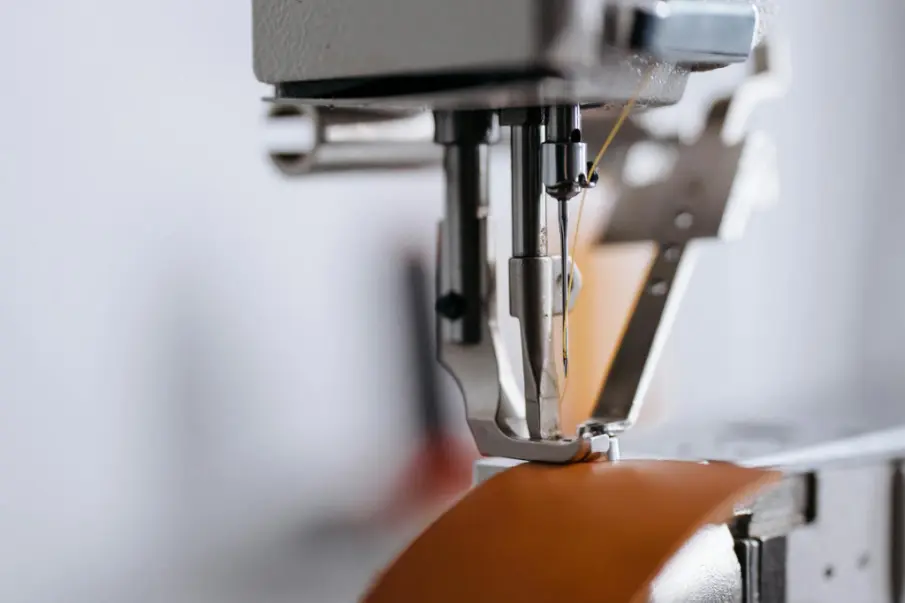
The modern industrial sewing machine has itself undergone a profound transformation. For decades, clutch motors drove sewing machines at a fixed speed, with operators managing speed through foot pedal pressure alone. The adoption of servo motors — electronically controlled motors that respond precisely to programmed or real-time input — has fundamentally changed what an industrial sewing machine can do.
Energy Efficiency and Speed Control
Servo motors consume energy only when stitching is actively taking place, unlike clutch motors that run continuously. Studies by industrial sewing machine manufacturers including Juki, Brother, and Pegasus have demonstrated energy savings of 50 to 70 per cent over clutch motor equivalents in production environments. Beyond energy saving, servo control enables precise speed modulation: machines can automatically slow at the beginning and end of a seam, at corners, or when sewing through thick seam intersections, and then accelerate to full speed along straight runs — all programmed without operator intervention.
Programmable Stitch Parameters
Contemporary industrial sewing machines store hundreds of programmable jobs in their electronic controllers. Stitch length, stitch density, seam tension, bartack positions, thread trimming sequences, needle positioning at stop, and feed dog movement can all be set, saved, and recalled instantly. When a factory switches from sewing denim jeans to lightweight shirt fabric, parameters are not adjusted manually — they are called up from memory within seconds, eliminating setup time and the risk of human error in adjustment.
Automatic Thread Trimming and Backtacking
Automatic thread trimming at the end of each seam, combined with automatic backtacking (reverse stitching to lock the seam), removes two of the most time-consuming manual tasks from the operator's responsibilities. Time-motion studies show that manual thread trimming can account for 15 to 25 per cent of cycle time on short seams. Automation of these tasks therefore yields substantial efficiency gains — typically translating to throughput increases of 20 to 30 per cent on equivalent operations.
"Servo-driven machines consuming 60% less energy, running stitch-perfect seams at 5,000 stitches per minute, and trimming their own threads — this is the new baseline for a competitive sewing floor."
4. Programmable Sewing Units (PSUs) and Automatic Sewing Machines
Programmable Sewing Units (PSUs) represent the next level of automation above the servo-driven single machine. A PSU combines a sewing head with a CNC-controlled clamping and movement system, allowing the fabric to be moved automatically through a programmed sewing pattern with no operator guidance of the material required.
PSUs are now used extensively for operations including pocket attachment, label sewing, emblem application, belt loop attachment, and the sewing of emblems and insignia onto garments. A pocket setter PSU, for example, receives a pre-folded pocket panel, clamps it against the garment body, and executes a precisely programmed stitch pattern around the pocket perimeter — including corners and securing tacks — in a cycle time that may be two to four seconds. The same operation performed manually by a skilled machinist might take eight to fifteen seconds and introduce significantly more variation in stitch quality and pocket positioning.
Manufacturers including Juki (with its AMS series), Brother (BAS series), and Dürkopp Adler offer extensive ranges of PSUs for specific applications. In denim manufacturing, PSU-based waistband and pocket operations have become near-universal in high-volume factories. Automotive seat cover manufacturing relies heavily on PSUs for the consistent sewing of complex curved seams in leather and technical fabrics.
5. Robotic Sewing Cells: Handling the Limpness Problem
The development of robotic sewing cells — in which a robotic arm or a purpose-built mechanical handling system feeds, positions, and guides fabric through a sewing machine — represents the frontier of sewn products automation. It is also where the challenges of fabric handling are most acute.
Vision-Guided Robotic Handling
Several approaches have emerged to managing limp fabric in robotic handling. SoftWear Automation, a US-based company, has developed its Sewbot platform, which uses dense arrays of cameras and real-time image processing to track the edge of fabric panels as they move through a sewing machine under robotic guidance. The system detects deformation and adjusts the path of the fabric in real time to maintain seam consistency, mimicking the continuous micro-corrections that a skilled machinist makes with their fingertips.
SoftWear's systems have been deployed in T-shirt and towel manufacturing, where relatively simple rectangular panels make robotic handling more tractable. The company has demonstrated lines capable of producing a T-shirt every 22 seconds with minimal human intervention — a throughput rate that rivals or exceeds conventional manual production lines operating with many more workers.
Specialised End-Effectors and Grippers
Robotic handling of textiles has driven significant innovation in end-effector design. Vacuum grippers, needle grippers that temporarily pierce the fabric for secure gripping, and compliant soft robotic fingers inspired by biomimetics have all been developed and refined for textile manipulation. The choice of end-effector depends on fabric type: a vacuum gripper that works well on tightly woven fabric may fail entirely on a knitted jersey that is porous to airflow.
Research institutions including the Institut für Textiltechnik (ITA) in Aachen and the Georgia Institute of Technology in Atlanta have published extensively on the gripper and sensing challenges of textile robotics, driving a growing body of solutions applicable to production environments.
6. Computer-Integrated Manufacturing and the Connected Sewing Floor
Automation of individual machines and processes is being amplified by the integration of factory information systems that connect every workstation, machine, and material flow on the production floor. Often described as the Industrial Internet of Things (IIoT) or Industry 4.0 in the context of sewn products manufacturing, this approach delivers efficiency gains that extend well beyond the capabilities of any single automated machine.
Real-Time Production Monitoring
Modern sewing machines equipped with sensors and network connectivity transmit data on stitch count, speed, downtime, thread breaks, and operator idle time to central manufacturing execution systems (MES). Factory managers can see live efficiency metrics for every station on the floor, identifying bottlenecks as they develop rather than discovering them hours later in end-of-shift reports. Companies such as Eton Systems (producers of unit production systems, or UPS) integrate material handling data with machine performance data to provide complete visibility of the production process.
Predictive Maintenance
Unplanned machine downtime is a significant source of production loss in sewing factories. IIoT-connected machines can monitor variables such as motor load, needle penetration resistance, and vibration patterns to detect the early signs of mechanical wear or misalignment before a breakdown occurs. Predictive maintenance programmes, enabled by machine learning models trained on historical fault data, have been shown in pilot deployments to reduce unplanned downtime by 30 to 40 per cent — a gain that translates directly into higher output and lower cost per unit.
Digital Work Instructions and Quality Assurance
Operator workstations equipped with screens displaying animated digital work instructions eliminate the need for paper specification sheets and reduce training time and error rates. Camera-based quality inspection systems, using convolutional neural networks trained on images of conforming and non-conforming seams, can detect skipped stitches, seam puckering, and incorrect stitch density in real time at the machine, allowing defects to be caught and corrected at source rather than after garment assembly.
7. Unit Production Systems and Automated Material Handling
The movement of partially assembled garments between sewing operations is itself a significant source of inefficiency in traditional bundle-based production systems. Workers spend time loading and unloading bundles, sorting components, and waiting for work to arrive at their station. Unit Production Systems (UPS), in which individual garment components are transported on overhead carrier systems from station to station under computer control, have transformed material flow in high-volume sewing factories.
Suppliers including Eton Systems, Dürkopp Adler's transport division, and Jensen Group provide UPS solutions that can move components directly to the operator who is next available rather than buffering work in front of every station. This balances the production line dynamically, reducing work-in-progress inventory and cutting the time from cutting room to finished garment from days (typical in bundle systems) to hours. In conjunction with automated sewing operations, a UPS creates a flow production environment that is both faster and more transparent than any traditional method.
8. Specialist Applications: Where Automation Has Already Won
Certain areas of sewn products manufacturing have already been substantially automated, with manual labour playing only a supervisory or exception-handling role.
- Hosiery and seamless knitwear: Fully automated knitting and sewing-finishing systems produce socks, tights, and seamless garments with minimal human involvement. Circular knitting machines capable of 1,600 courses per minute operate unattended for extended periods.
- Carpet and rug manufacturing: Tufting machines and weaving looms for floor coverings operate under full computer numerical control, producing complex patterned carpets at speeds and repeatability levels no human-operated system could approach.
- Technical textiles and airbags: Automotive airbag manufacturing operates in tightly controlled, largely automated environments. The safety-critical nature of the product demands the stitch consistency and traceability that automated systems provide.
- Workwear and uniform production: High-volume, standardised styles produced in large quantities are particularly well-suited to automation. Modular robotic sewing lines for standardised shirt and trouser styles have achieved cost parity with manual production in low-wage markets in several documented deployments.
- Mattress and upholstered furniture production: Panel quilting machines, border sewing systems, and automated panel handlers have transformed mattress manufacturing. Multi-needle quilting machines producing complex quilt patterns at speeds exceeding 1,000 stitches per minute per needle head now operate with one or two attendants where formerly a large crew was required.
9. The Role of Artificial Intelligence and Machine Learning
Artificial intelligence is not merely enhancing existing automation in the sewn products industry — it is enabling forms of automation that were previously technically infeasible. Three areas are particularly significant.
Pattern Grading and Technical Specification
AI-driven grading systems can now automatically generate a full size range from a base pattern, applying rules that adapt proportions intelligently rather than simply scaling uniformly. This eliminates weeks of skilled pattern grader time per style and feeds directly into the automated cutting room.
Adaptive Sewing Control
Machine learning models trained on sensor data from the sewing process can adapt machine parameters in real time in response to detected variations in fabric thickness, density, or slippage. A sewing machine that automatically adjusts presser foot pressure and feed rate when it detects that it is approaching a multi-layer seam intersection — without any pre-programming of that specific intersection — exemplifies the intelligence now being embedded in advanced sewing systems.
Defect Detection and Quality AI
Computer vision systems backed by deep learning models are replacing or supplementing human quality inspection. Systems deployed in production environments can inspect seams at machine speed, detecting defects invisible to the human eye under normal inspection conditions. As these models are trained on larger datasets, their accuracy continues to improve, and their deployment is becoming economically viable even for medium-scale manufacturers.
10. Near-Shoring, On-Demand Manufacturing, and the Strategic Case for Automation
The economic geography of sewn products manufacturing is shifting, and automation is a central driver of that shift. For decades, low labour costs in Bangladesh, Vietnam, Cambodia, and other developing nations made offshore manufacturing the default strategy for brands serving Western markets. Rising wages in those markets, combined with the disruptions of the COVID-19 pandemic and subsequent supply chain crises, have accelerated industry interest in near-shoring — producing closer to the end market.
Near-shoring is only viable when labour cost differentials can be overcome. Automation provides the mechanism: a highly automated factory in Europe or North America, operating with a fraction of the headcount of an equivalent manual factory in Asia, can approach cost competitiveness while offering dramatically shorter lead times, tighter quality control, and lower logistics costs. The on-demand manufacturing model — producing small quantities quickly in response to actual demand rather than forecasted orders — is uniquely suited to automated factories that can switch between styles rapidly without the setup time penalties of manual production.
Companies including Adidas, with its now-discontinued but highly influential Speedfactory project, and various European denim manufacturers have demonstrated that highly automated near-shored production is technically feasible. The lessons learned from these projects continue to inform the industry's investment decisions.
11. Challenges and Limitations That Remain
Honesty requires acknowledging that significant challenges remain in the automation of sewn products manufacturing, and that not all segments of the industry are equally amenable to the technologies described above.
- Style complexity and variability: High-fashion garments, tailored clothing, and products with intricate three-dimensional shaping remain largely dependent on skilled human machinists. The number of different styles a typical apparel brand produces — often thousands per season — creates tooling and programming costs that erode the return on investment in automation for all but the highest-volume styles.
- Capital intensity: High-quality automated sewing systems, robotic cells, and computer-integrated manufacturing infrastructure require significant capital investment. For smaller manufacturers, particularly in developing markets, access to finance for such investment is constrained.
- Skilled workforce transition: Automation requires a different workforce — fewer machinists and more technicians capable of programming, maintaining, and optimising complex automated systems. Upskilling existing workforces and recruiting new technical talent is a genuine organisational challenge.
- Flexible material handling at scale: Despite the impressive advances described above, the fully automated sewing of complex three-dimensional garments from cut panels remains beyond the reliable capabilities of available systems at commercially viable cost. Robotic sewing is advancing rapidly but has not yet displaced the skilled machinist in complex assembly operations.
12. The Road Ahead: An Industry in Transition
The trajectory is clear. The convergence of robotics, artificial intelligence, advanced sensors, and networked manufacturing systems is creating conditions in which the most labour-intensive elements of sewn products manufacturing are progressively amenable to automation. Industry analysts project that the share of sewing operations that can be cost-effectively automated will grow from roughly 20 per cent today to over 50 per cent within the next decade, as the cost of robotic systems continues to fall and their capability continues to rise.
The transition will be uneven. Commodity products — basic T-shirts, socks, bed linen, simple workwear — will automate first and most completely. Complex, fashion-forward, or highly customised products will remain dependent on human skill for longer, though the tools available to skilled workers will become progressively more powerful. The relationship between human expertise and machine capability will evolve from the machinist as operator to the machinist as supervisor, quality arbiter, and problem-solver.
For manufacturers, the strategic imperative is not simply to automate for its own sake, but to identify the specific operations and product categories where automation delivers the greatest gains in speed, consistency, and cost — and to invest accordingly. For brands and retailers, the availability of near-shored, highly automated production opens new possibilities for responsiveness, sustainability, and product quality that may reshape competitive dynamics across the industry.
"The factories of the future will not be built around the manual dexterity of thousands of machinists, but around the intelligent integration of machines, data, and a smaller, more highly skilled human workforce."
Conclusion
Automation is not a future possibility for the sewn products industry — it is a present reality that is accelerating. From the servo-driven sewing machine on the individual workstation to the fully robotic sewing cell guided by computer vision, from the IIoT-connected factory floor to the AI-driven quality inspection system, the mechanisms of transformation are already in operation in factories around the world.
The efficiency and speed gains that automation delivers — measured in reduced cycle times, lower defect rates, higher output per worker, and faster response to demand — are compelling and, in many product categories, decisive competitively. The manufacturers, brands, and supply chain partners who understand and invest in these technologies will define the industry's next chapter. Those who do not risk being left behind by a transformation as profound as any in the long history of the sewn products trade.
Previous Posts: